AI Booking Agent for Hair and Beauty Salons in Sri Lanka
Let’s chat on WhatsApp
AI Booking Agent for Hair and Beauty Salons in Sri Lanka: Stop Losing Appointments to a Missed Call
An AI booking agent for hair and beauty salons in Sri Lanka is not a luxury upgrade for a high-end Colombo spa. It is a practical fix for one of the most common and most costly problems in the salon business — the appointment that never got booked because nobody answered the phone.
If you run a salon, you already know what that looks like. The phone rings during a colour treatment. You are elbow-deep in a blowout. Your front desk person has stepped out. The caller waits four rings, then hangs up. That was a booking worth Rs. 3,500 to Rs. 8,000 that just walked straight to the salon down the road.
This article is about why that keeps happening, and what a voice agent actually does to stop it.
The Appointment Booking Problem in Sri Lanka’s Salon Industry
Most salons in Sri Lanka — from Colombo 3 to Kandy to Galle — operate on a very thin margin between fully booked and half-empty.
The difference is rarely the quality of the service. It is the quality of the system that captures demand.
Walk into most salons and you will find bookings managed through one of three ways: a physical appointment book, a personal WhatsApp, or word of mouth with a call-back later.
None of those systems work when the phone rings at 7 PM on a Saturday and your stylists are finishing their last two clients of the day.
Beyond missed calls, there is double-booking. Two clients arrive at the same time for the same stylist. One of them waits. One of them never comes back.
There is the no-confirmation problem. A client books on Tuesday for Saturday, nothing is sent to them, life gets in the way, and they forget. Your stylist sits idle for an hour.
These are not edge cases. These are standard weekly events in salons that are not running a structured booking system.
What an AI Booking Agent for Hair and Beauty Salons in Sri Lanka Actually Does
The AI booking agent answers your salon’s incoming calls. Every call. Every hour. Every day 24/7.
It does not sound like an automated menu system. It conducts a natural conversation — asks the client what service they are looking for, which stylist they prefer if they have one, what date and time works for them, and confirms the appointment before ending the call.
It is trained on your salon specifically.
That means it knows your service menu — haircuts, colouring, keratin treatments, facials, waxing, nail services, whatever your salon offers. It knows your pricing. It knows your stylist roster and their individual working hours. It knows which slots are already taken and which are available in real time.
When the call ends, two things happen immediately.
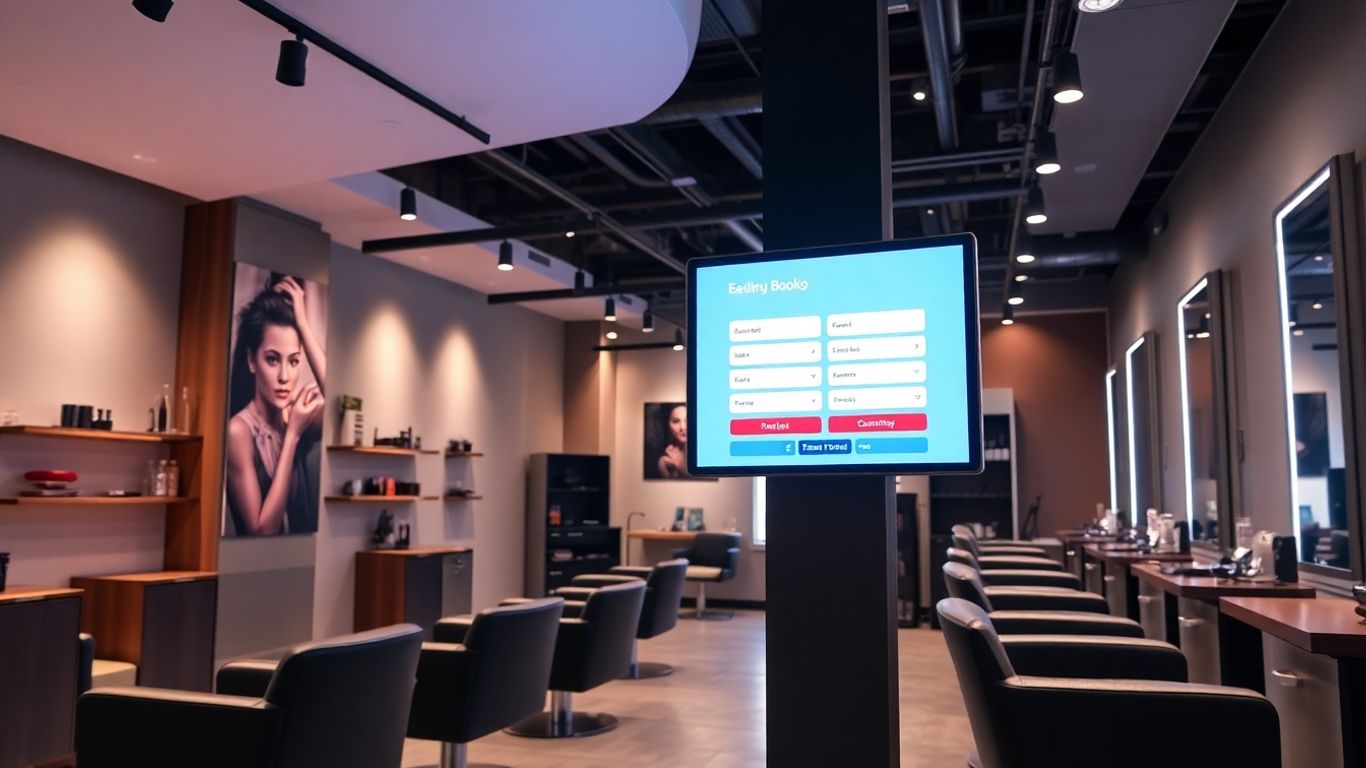
The client receives a confirmation message with their appointment details — service, stylist name, date, time, and your salon address. Your appointment dashboard updates with the new booking, visible to your reception and management.
No handwriting. No WhatsApp note to follow up on. No risk of a double-booking because two people were updating the diary at the same time.
Let’s chat on WhatsAppTrained on Your Salon — Customise the Ai Agent to your Business
This is the part that separates a real AI booking agent for hair and beauty salons from a generic chatbot.
Your Salon Service Menu, Your Pricing, Your Language
The agent is trained before it goes live.
If you offer a Brazilian blowout, a scalp treatment, semi-permanent lash extensions, and an express facial — the agent knows all of those by name. It knows the duration of each service, so it blocks the correct slot in the schedule. A 90-minute full colour and cut does not get squeezed into a 45-minute window.
Pricing queries get answered accurately. If a new client calls and asks what a highlights treatment costs, the agent gives the correct answer — not a guess, not a “please hold while I check.”
If your salon serves clients in Sinhala, Tamil, or English, the agent can be configured to handle calls in any of those languages. For salons outside of Colombo where the majority of callers speak Sinhala, this is not optional — it is essential.
Stylist Schedules and Preferences
Many clients book for a specific stylist. They have been going to the same person for two years and they are not interested in being reassigned.
The agent understands this. It checks the named stylist’s availability and either confirms the slot or offers the next available time with that specific person.
If the client has no preference, it offers the earliest available slot across your team.
Special Requests and Notes
Bridal trials. Client with a sensitive scalp. A repeat client who always prefers to sit near the window. A group booking for a hen party.
The agent captures these notes during the call and they appear in the booking record on your dashboard. Your team sees them before the client walks through the door.
The Salon Confirmation Message and the Ai Dashboard — Where the Real Value Shows Up
The confirmation message is not just a courtesy. It cuts no-shows.
When a client receives a message immediately after booking — with their name, appointment time, stylist, and service — they have a written record they will refer back to. The no-show rate in salons that send booking confirmations is consistently lower than those that rely on verbal agreements.
For your team, the dashboard view is where operations get cleaner.
The daily appointment sheet is populated automatically from every call the agent handles. Your reception sees the full day at a glance — who is coming in, at what time, for which service, with which stylist, and any notes the client provided.
The call log sits alongside it. If a client disputes a booking time or a price they were quoted, the record of the call is there. There is no argument about what was said.
Management gets a broader view over time. Which services are booking fastest. Which stylist is at full capacity three weeks in advance. Which day of the week is consistently under-booked and needs a promotion to fill it.
This data does not require extra work to generate. It accumulates from the calls the agent handles every day.
The Cost Conversation — What the Rental Model Means for a Salon
Hiring a dedicated front desk person for your salon in Sri Lanka costs a minimum of Rs. 45,000 to Rs. 65,000 per month when you include statutory contributions. That person works eight hours a day, five or six days a week. They do not answer calls before they clock in. They do not take messages after they leave. And when they resign — which in the salon industry happens more often than most owners would like — you start the hiring and training process again.
The TaskForce AI booking agent operates 24/7 on a fixed monthly rental. It answers calls from the moment your salon’s number is active until you decide to stop the service. There is no recruitment cost. No training period. No leave to manage.
For a salon doing 60 to 100 appointments per week, the agent typically pays for itself within the first month through captured bookings that would otherwise have been missed calls.
That is not a projection. That is what happens when every call gets answered and every booking gets confirmed.
How TaskForce AI Sets Up the Agent for Your Salon
The process is not complicated.
We start with a briefing — your service list, your pricing, your stylist roster, their individual working hours, your booking policies, and any specific client handling preferences you have.
From that, we build and train the agent on your salon’s specifics.
We test it with real call scenarios before it goes live — simulating a first-time client, a repeat client booking for a named stylist, a group booking inquiry, a call in Sinhala, a caller who changes their mind mid-conversation.
When it passes testing, it goes live on your number.
From that point, you rent the agent on a monthly basis. When your service menu changes — new treatments added, prices revised, a stylist leaves or joins — the agent is updated as part of the arrangement. You are not managing a software subscription. You are working with a service that adapts to your business.
Real Talk — What the Agent Does Not Do
The AI booking agent handles inbound booking calls. That is its specific function.
It does not manage the physical flow of clients in your salon on a busy Saturday afternoon. It does not handle complaints from a client who is unhappy with their colour result. It does not replace the skilled people behind your styling chairs.
What it does is take the one task that gets dropped most consistently in a busy salon — answering the phone and capturing the booking accurately — and handle it without fail, at any hour, on any day.
Your team focuses on the clients in the chair. The agent handles the clients calling in. That division of responsibility is what makes the system work.
Conclusion: Every Missed Call Is a Booking Your Competitor Got
The salon business in Sri Lanka is built on repeat clients and word of mouth. Both of those depend on one thing — a client who had a good experience and wants to come back.
They cannot come back if their call never got answered the first time.
An AI booking agent for hair and beauty salons in Sri Lanka closes that gap. It answers every call. It books every appointment accurately. It sends confirmation to the client and updates your team’s dashboard — all without a single staff member involved.
TaskForce AI builds and rents these agents, customised to your salon’s specific setup — your menu, your team, your language, your workflow.
Call Chrys Fernando at 0776697566 to discuss what the agent would look like for your salon.
Visit taskforceai.tech to see what we build and how it works.
Email us directly at chrys@taskforceai.tech if you want to start with a written conversation.
Frequently Asked Questions
Q: Can the AI booking agent handle multiple stylists with different working hours?
A: Yes. Each stylist’s schedule is configured individually. If one stylist works Tuesday to Saturday and another works Sunday to Friday, the agent knows this and only offers availability that matches the correct working pattern. Requests for a specific stylist on their day off are handled accurately — the agent offers their next available day rather than booking into a slot that does not exist.
Q: What happens to bookings that come in outside of salon hours — late at night or early morning?
A: This is one of the primary reasons salons move to a voice agent. The agent is active around the clock. A client who calls at 10:30 PM on a Sunday to book for Wednesday morning will have their appointment confirmed immediately — with a confirmation message — without anyone at the salon needing to be involved. Those bookings sit in the dashboard ready for your team when they open in the morning.
Q: How does the agent handle a caller who wants to reschedule or cancel an existing appointment?
A: Rescheduling and cancellation handling is configured during the setup process. The agent can be trained to handle these calls — verifying the booking, offering alternative slots for reschedules, and updating the dashboard accordingly. The exact flow depends on your salon’s cancellation policy, which is factored into the agent’s training before it goes live.
TaskForce AI (Private) Limited — Offices in Colombo, Dubai, and Muscat.
Company: Taskforce AI
Address: Nugegoda Business Center, Unit 37, 2nd Floor, 80 Nawala Rd, Nugegoda 10250
Phone: +94 77 669 7566
Website: https://taskforceai.tech/
Let’s chat on WhatsApp
Let’s Chat on WhatsApp
Why AI Agents Matter for Sri Lankan Businesses Right Now
AI agents are changing how businesses across Colombo, Kandy, Galle, and the wider South Asian region run their operations. Unlike basic chatbots or scripted workflow tools, autonomous AI agents reason through tasks, hold context across conversations, and take action directly inside your existing business systems.
For Sri Lankan companies facing rising operational costs, talent retention pressures, and growing customer expectations for 24/7 service in Sinhala, Tamil, and English — AI automation in Sri Lanka is no longer a future-state initiative. It is an immediate lever for OPEX reduction, customer experience improvement, and scaling output without expanding headcount.
This guide walks Sri Lankan business owners, IT managers, and operations leaders through the practical steps of integrating AI agents into your business — with the local context, regulatory awareness, and cost realities that matter on the ground.
What Are AI Agents and How Do They Work?
AI agents are autonomous, decision-making systems that combine reasoning, memory, and tool access to complete real business tasks end-to-end. Where a chatbot replies and an automation script executes a fixed sequence, an AI agent thinks, plans, and acts — handing off to a human only when business rules or risk thresholds require it.
The core building blocks of a modern AI agent are:
- Reasoning and planning — evaluating context, applying business rules, and breaking down multi-step workflows.
- Memory and context — retaining customer history, prior conversations, and transactional data across a task.
- Tool and function calling — connecting to your CRM, ERP, WhatsApp, email, accounting system, or core banking platform to take real actions.
- Guardrails and human review — enforcing security controls, compliance checks, and escalation paths.
For Sri Lankan businesses, this means an AI agent can take an inbound voice call in Sinhala, log a motor insurance FNOL claim, check stock availability in your inventory system, send a WhatsApp confirmation, and escalate to a human agent only when the case falls outside its confidence threshold — all without a single staff member touching the workflow.
AI Agents vs Chatbots vs RPA vs Copilots: What’s the Difference?
| Technology | Primary Function | Typical Sri Lankan Use Case | Limitations | Autonomy |
|---|---|---|---|---|
| Chatbots | Scripted Q&A and text dialogs | FAQ handling on hotel or restaurant websites | Static logic, no context retention | Low |
| RPA | UI automation of repetitive tasks | Data entry between disconnected systems | Breaks easily when UIs change | Medium |
| Copilots | Assistive suggestions inside apps | Drafting emails, suggesting code | Only responds when prompted | Low to Medium |
| AI Agents | Reasoning + autonomous action | End-to-end voice agents, booking agents, document processing | Needs quality data and oversight | Medium to High |
AI agents do more than chat — they execute workflows, adapt to exceptions, and escalate intelligently. For Sri Lankan businesses moving beyond first-generation chatbots, this is the meaningful step up.
Where AI Agents Fit in Your Business Stack
AI agents sit in the operational layer between your business logic and your transactional systems. They interact with databases, POS systems, CRM platforms, booking engines, and accounting tools through secure APIs. Properly integrated, AI agents support digital transformation across unstructured document processing, voice-based customer engagement, and cross-platform workflow orchestration — grounded in your actual business data and policies.
Let’s Chat on WhatsApp
When AI Agents Make Sense for Sri Lankan Businesses
AI automation delivers the strongest ROI when applied to workflows that are high-volume, repeatable, and well-documented. Not every process is a candidate. Weigh feasibility, business value, and organizational readiness before deploying.
High-Value Use Cases for AI Agents in Sri Lanka
- High-volume, repetitive tasks — motor insurance claims intake (FNOL), bank loan pre-qualification calls, hotel and villa booking enquiries, restaurant reservations.
- Document processing — extracting data from PDFs, contracts, customs paperwork, NIC scans, and receipts.
- Business intelligence and reporting — automated daily sales reports, anomaly detection in transactions, KPI dashboards.
- Voice agent automation — multilingual inbound and outbound calls in Sinhala, Tamil, and English for customer enquiries, appointment booking, and data collection.
- Cross-platform workflow orchestration — moving data between WhatsApp Business, email, Google Sheets, your CRM, and your accounting tool.
Workflows to Avoid for Now
- Low-frequency, ad-hoc tasks — uniquely customized processes that don’t repeat.
- Strategic or creative decisions — executive judgment, brand creative, or ambiguous requirements.
- Regulated actions without oversight — payment approvals, legal execution, HR decisions all require structured human supervision.
Is Your Sri Lankan Business Ready for AI Automation?
You’re a strong candidate for AI agent integration if you have:
- Established digital infrastructure and at least partially documented processes.
- Data accessible through APIs, exports, or structured files.
- Leadership sponsorship — typically the MD, CEO, or Head of Operations.
- Basic data privacy and governance practices in place.
- A genuine appetite to move past surface-level automation and into intelligent workflow transformation.
Step-by-Step Guide to Integrating AI Agents in Your Sri Lankan Business
Step 1 — Audit Your Existing Workflows
Start with a structured audit. You can’t automate what you haven’t mapped.
- Document repetitive, high-volume, and error-prone tasks across your operation.
- Map every process stage — inputs, decision points, handoffs, outputs, exceptions.
- Identify manual data re-entry, rework, and compliance checks.
- Note which roles own which steps.
- Highlight bottlenecks and steps that rely heavily on human judgment.
Prioritize workflows using four criteria: time savings, manual effort reduction, risk or regulatory value, and feasibility based on your current systems and data availability.
Step 2 — Define the Business Goal and Success Metrics
Be specific. “Reduce invoice approval cycle from three days to three hours” is useful. “Improve operations” is not.
Define KPIs upfront:
- Cycle time (time to completion)
- Accuracy improvement or error reduction
- Throughput (tasks per day or per agent)
- Customer satisfaction or response time
- OPEX reduction or FTE reallocation
Capture your pre-automation baseline. Without it, you cannot prove ROI later.
Step 3 — Prepare Data and Knowledge Sources
Reliable AI agents need reliable data. Many Sri Lankan businesses underestimate this step and pay for it later.
- Cleanse and standardize data — remove duplicates, normalize fields, resolve inconsistencies, ensure recency.
- Define agent-accessible sources — identify which databases, file shares, and knowledge repositories the agent will use, with proper access controls.
- Implement retrieval-augmented generation (RAG) — connect your agent to internal documents, SOPs, pricing sheets, and product catalogues so it grounds every response in your real business context.
Unstructured or legacy data multiplies risk. Sensitive datasets — customer NICs, payment information, medical records — must remain compliant with the Personal Data Protection Act of Sri Lanka and should always pass through human review before agent exposure.
Step 4 — Choose the Right Use Case and Scope
Start narrow. Scale fast. The most successful Sri Lankan AI deployments we see at TaskForce AI begin with one well-bounded workflow.
- Pick a high-value, well-structured workflow with clear rules.
- Document boundaries and exceptions explicitly — what’s in scope, what isn’t.
- Assign an autonomy level appropriate to the risk:
- Read-only — agent reviews and suggests, but does not execute.
- Suggestion / draft — agent prepares the action, human approves.
- Full autonomy — agent executes for low-risk, high-confidence steps.
Step 5 — Design the AI Agent Workflow
Workflow design is where projects succeed or stall. Map it out before you build.
- Inputs — what triggers the agent? An inbound call, a new email, a webhook, a document upload?
- Decision points — what business rules and validation logic apply at each step?
- Actions — what does the agent do? Update a record, send a WhatsApp message, generate a quote, book a slot?
- Outputs — where do results land? CRM, dashboard, email, Google Sheet?
- Integrations — every API call should be secure, logged, and auditable.
- Human-in-the-loop checkpoints — where does the agent pause for sign-off?
Document every branch. Traceability is non-negotiable, especially in regulated industries like banking and insurance.
Step 6 — Put Guardrails and Governance in Place
Governance is what separates a working prototype from a production-grade deployment.
| Risk | Example Failure | Control | Owner |
|---|---|---|---|
| Excess permissions | Agent edits records it shouldn’t touch | Least-privilege access | IT / Security Lead |
| Inappropriate actions | Sending unapproved emails or payments | Human sign-off checkpoints | Workflow Manager |
| Data access breaches | Customer data exposure | Redaction and access controls | Data Protection Lead |
| Out-of-scope execution | Agent acting outside hours or scope | Policy rules and escalation | Compliance Officer |
| Incident gaps | No rollback after failure | Fallback, rollback, pause plans | IT / Support |
Implement: least-privilege permissions, approval flows, comprehensive logging, regular control reviews.
Step 7 — Test in a Safe Environment
Don’t rush from prototype to production.
- Offline testing — run staging data through the agent and compare outputs against a human benchmark.
- Shadow runs — let the agent run alongside your team, observing live traffic without taking action.
- Edge case simulation — deliberately throw ambiguous, rare, and broken inputs at the agent.
- Hallucination probes — confirm the agent does not invent facts, prices, or policies under pressure.
- Log review — examine every transaction during testing for anomalies.
Workflow owners and IT must sign off jointly before live deployment.
Step 8 — Deploy Gradually
- Pilot launch — activate the agent for a small user group or data subset.
- Internal testing — let trusted internal teams trial the agent and feed back.
- Broader rollout — expand to additional teams, branches, or workflows.
- Change management — train your team, publish FAQs, set up support channels. People accept what they understand.
Step 9 — Monitor, Measure, and Improve
AI agent deployment is not a one-time project. It is an operational capability that needs ongoing attention.
- Monitor KPIs against your Step 2 baseline.
- Collect structured feedback from staff and customers.
- Track errors, drift, and confidence-score patterns.
- Iterate on agent logic, prompts, and security rules.
- Expand strategically — once one agent stabilizes, add the next workflow.
Let’s Chat on WhatsApp
Common Pitfalls Sri Lankan Businesses Should Avoid
- Starting too broad — pick one workflow, win, then scale.
- Neglecting data quality — automation amplifies bad data exponentially.
- Weak governance — no permissions, no logs, no audit trail is a future incident waiting to happen.
- No fallback plan — always have a way to pause, revert, or escalate to humans without service disruption.
- Tracking technical metrics only — ROI lives in business outcomes: OPEX, cycle time, NPS, FTE reallocation. Not model accuracy in isolation.
How TaskForce AI Helps Sri Lankan Businesses Deploy AI Agents
TaskForce AI is a Sri Lankan AI automation agency headquartered in Colombo, with deployments across banking, insurance, hospitality, restaurants, and government tourism. Our voice agents handle inbound and outbound calls in Sinhala, Tamil, and English with a 65–70% call resolution rate and 99% data accuracy — 24 hours a day, with no shift breaks and no attrition.
We work with clients across Sri Lanka, the UAE, and Oman on voice agent deployment, N8N workflow automation, document processing, and custom AI-powered dashboards. Every engagement follows the structured roadmap above, with full governance, multilingual capability, and OPEX-focused outcomes.
If you’re considering AI automation for your Sri Lankan business, get in touch with the TaskForce AI team for a workflow audit and demo.
Frequently Asked Questions About AI Agents for Sri Lankan Businesses
Q: What is an AI agent and how is it different from a chatbot used by Sri Lankan companies?
A: An AI agent is an autonomous system that reasons, plans, and takes real action across your business systems — placing calls, updating records, sending messages, processing documents. A chatbot only responds with scripted text inside one channel. For Sri Lankan businesses, the practical difference is this: a chatbot answers “what are your opening hours?”, an AI agent takes the booking, confirms it on WhatsApp, updates your booking system, and sends a reminder the day before — all in Sinhala, Tamil, or English, around the clock.
Q: How much does AI automation cost for a small or mid-sized business in Sri Lanka?
A: AI automation pricing in Sri Lanka depends on three factors: the use case (a single voice agent costs significantly less than a multi-system document processing pipeline), call or transaction volume, and the level of integration with your existing systems. Most TaskForce AI deployments are structured on an OPEX model — a fixed monthly fee covering hosting, support, and improvements — making the cost directly comparable to the salary of one staff member while delivering 24/7 multilingual capacity. A workflow audit and scoped quotation typically takes one to two weeks.
Q: Can AI agents handle Sinhala and Tamil for Sri Lankan customer service?
A: Yes. TaskForce AI voice agents handle inbound and outbound calls in Sinhala, Tamil, and English, with the agent automatically detecting the language the customer prefers. The production pattern most Sri Lankan businesses use combines a multilingual understanding layer — which interprets the customer’s speech in any of the three languages — with a response layer tuned to the agent’s brand voice. This delivers natural conversation quality without the brittleness of older translation-based approaches, and it scales across banking, insurance, hospitality, and restaurant use cases.
This guide is provided for general orientation. For workflows involving regulated activity, financial transactions, or business-critical decisions, combine AI agent deployment with qualified human oversight and consult appropriate compliance experts before full automation.
Taskforce AI – Explore Our Solutions: Visit taskforceai.tech
Chat with us on WhatsApp (0776697566)
Let’s Chat on WhatsApp